Anyone who wants to understand energy prices today must first look at the mechanism that determines them: the merit order.
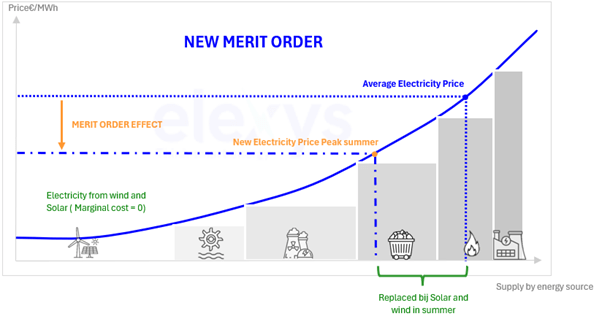
In the electricity market, generation units are dispatched according to their cost, from the cheapest to the most expensive. The merit order determines the electricity price by ranking generation technologies based on their marginal cost: renewable sources such as wind and solar are at the front of the queue and are always dispatched first, followed by hydropower, biomass, and nuclear energy. Fossil-fuel power plants come next, with the order between coal and gas depending on fuel and CO₂ prices, while the most expensive peaking plants are positioned at the end of the stack.
The market price is then set by the last—and therefore most expensive—power plant required to meet demand. This explains why natural gas often determines the electricity price in many market situations.
Although the extreme price spikes of recent years appear to be behind us for the time being, price levels remain structurally higher than before. Whereas electricity prices used to trade around €50/MWh, we now typically see a more stable range between €70 and €100/MWh.
More important than the absolute price level, however, is how prices are formed and how strongly they are influenced by seasonal factors and the role of natural gas within the energy system.
Summer and winter: two completely different markets
The merit order clearly illustrates why prices now differ significantly between seasons. In summer, the abundance of solar and wind energy increasingly leads to situations where low-cost generation is sufficient to meet demand. More expensive power plants are then pushed out of the market, resulting in low prices and, in some cases, even negative prices.
In winter, this logic is reversed. Electricity demand increases, renewable generation becomes less predictable, and gas-fired power plants once again become necessary to maintain system balance. These plants then set the market price, which explains why electricity prices in winter move so closely in line with developments in the gas market.
This seasonal pattern is not a temporary phenomenon but a structural reality that requires a different approach. A uniform pricing strategy is no longer sufficient: companies face a dual challenge—protecting themselves against winter price risks while still benefiting from lower summer prices. As a result, energy management is evolving from an administrative decision into a strategic component of business operations.
A market that remains vulnerable to shocks
Even more important than the price level is the nature of the market itself. Over the past few years, the energy market has demonstrated that stability cannot be taken for granted.
Recent tensions involving Iran provide a clear example. Concerns surrounding the Strait of Hormuz, a critical transit route for oil and LNG, once again created nervousness in the markets and triggered sudden price increases.
Compared with 2022, however, the current situation is less severe. While the shortage at that time emerged suddenly and was concentrated in Europe, today's impact is more dispersed across global markets. As a result, pressure on energy markets is shared among different regions, creating tensions that are less abrupt but more persistent.
Although prices have since eased again, the message remains clear: Europe continues to rely heavily on international energy flows and therefore remains vulnerable to geopolitical developments. Even temporary disruptions can have long-lasting effects on both prices and energy supply.
Heading into winter: a fragile balance
European gas storage facilities have not yet been fully replenished and will need to be further filled over the coming months. At the same time, competition in the global LNG market remains intense, with other regions competing for the same volumes.
Combined with ongoing geopolitical uncertainty, continued dependence on imports, and the typical winter peak in demand, this creates a fragile balance. The current calm in the market can therefore be misleading. The risk of renewed upward pressure on prices during Q4 2026 and Q1 2027 remains very real.
From fixed choices to smart combinations
Where companies once tended to choose between fully fixed or fully variable energy contracts, we are now seeing a shift towards hybrid strategies. The logic is simple: secure certainty when risk is greatest, while maintaining flexibility when the market presents opportunities.
It is from this market reality that solutions such as Elexys' WinterFreeze product have emerged.
This approach is designed around the seasonal dynamics of the market: winter volumes (Q1 and Q4) are fixed gradually and in advance, while summer consumption remains linked to the variable market. At the same time, unnecessary hedging is avoided during periods of relatively low consumption.
Notably, these types of strategies are now also accessible to companies with relatively modest energy consumption (from approximately 100 MWh onwards). This enables a broader range of organisations to actively manage their energy costs.
Conclusion: looking ahead pays off
The current calm in the market should not be mistaken for long-term stability. On the contrary, periods of relative calm often provide the greatest opportunities to manage risks and optimise strategies.
For businesses, this means one thing above all: having the confidence to look ahead to winter—before the market starts moving again.
Anyone interested in exploring how a seasonal energy procurement strategy could work in practice within their organisation is always welcome to discuss it with us, free of obligation.
Contact us today: https://www.elexys.be/contact/